
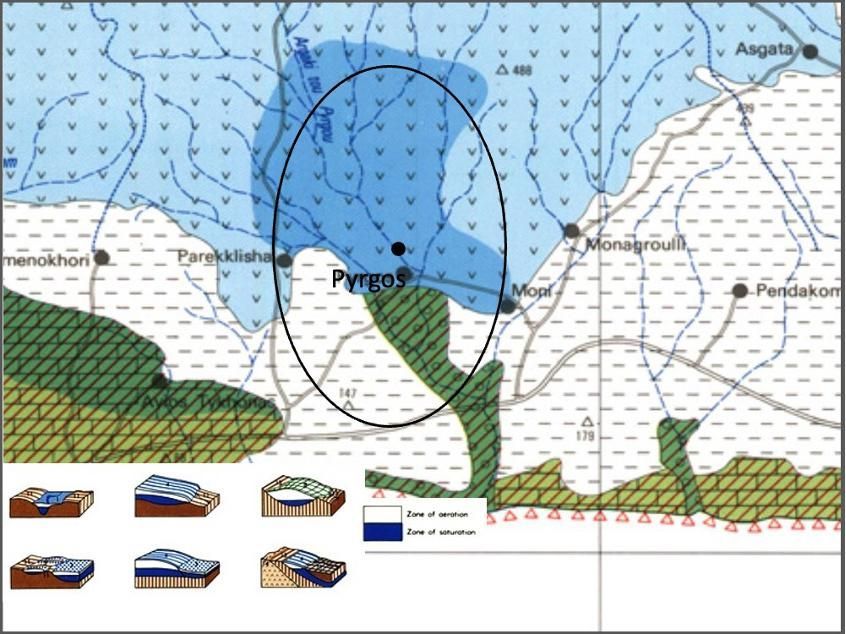
The site is located on a system of river terraces that descend from the Troodos Mountains to a low alluvial valley where a fan of streams converges four kilometres from the coast, once part of the sequence of wetlands that characterized the southern coast of Cyprus from the Akrotiri peninsula to the Gulf of Famagusta
Pyrgos/Mavroraki:
The Palaeolithic frequentation of the palimpsest site
Pyrgos-Mavroraki is known as the heart of a vast Early and Middle Bronze Age settlement in Cyprus, investigated by the Italian National Research Council (CNR) archaeological mission from 1996 to 2012 (for a detailed description, go to
www.pyrgos-mavroraki.eu). However, more recent research based on the typological analysis of over 6,000 chipped stone tools suggests that the area was inhabited by human groups, many thousands of years earlier, becoming a palimpsest site in the strictly archaeological sense. Long periods of abandonment and renewed occupation, and technological signatures belonging to different Palaeolithic and Neolithic traditions, provide evidence of surprising longevity.
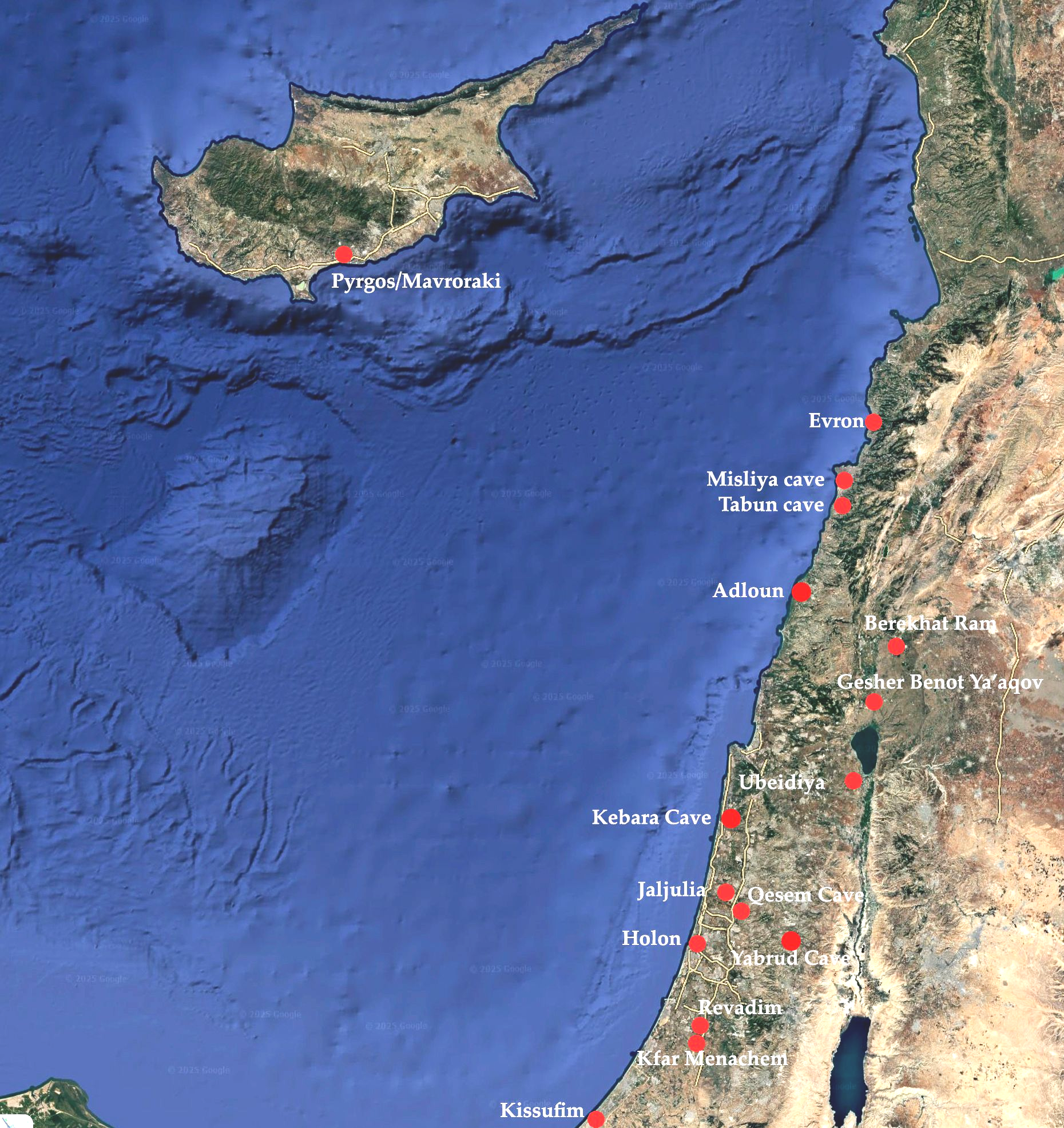
The lithic production displays a combination of technological systems strongly reminiscent of Levantine sites in the Syro-Palestinian corridor such as Qesem cave, Tabun cave, Kebara cave, Yabrud cave, Adloun, from which Pyrgos/Mavroraki differs significantly, as the insularity and a diverse raw material landscape created the conditions in which Levantine technological repertoires were transformed and recombined in a local technological hybridization.
The presence of such an ancient assemblage of stone tools, far from being a coincidence with the later Neolithic occupation of Pyrgos/Mavroraki, provides unsurprising evidence of human presence in Cyprus at the beginning of the Middle Palaeolithic, placing the island among the best-known Mousterian sites in the Levant.
The coexistence of technological traditions associated with the late Lower Palaeolithic – early Middle Palaeolithic (e.g., Tayac tools) with unambiguously late Acheulean, Tayac, Quinson, Quina and Levallois artefacts strongly suggests that human groups visited Cyprus repeatedly from the Levantine coast, probably starting from the Lower Palaeolithic.
The first Techno-Cultural Phases regard the end of the Acheulean period.
a.The Late Acheulean (LA, 780–400 ka)
The Late Acheulean of the Levant is characterised by well-shaped bifaces, refined flint workmanship, and hierarchical flaking strategies. Detailed analyses of key open-air sites such as Kefar Menahem West, Revadim, and Holon demonstrate substantial intra-assemblage variability in raw material procurement, reduction sequences, and tool types. Contrary to the traditional view of the Acheulean as a phase of cultural stasis, the Levantine evidence reveals significant local experimentation and technological flexibility, suggesting small, low-density populations capable of innovation, albeit with limited intergroup transmission.
b.The Acheulo-Yabrudian (A-Y, 400–250 ka)
The Acheulo-Yabrudian (A-Y) complex represents a genuine transitional phase between the Acheulean and the Middle Palaeolithic. Documented at sites such as Zuttiyeh Cave, Tabun (Layers E–F), and Qesem, the A-Y assemblages display a mixed technological repertoire:
● Persistence of bifaces, though in reduced frequency.
● Emergence of intentional thick-flake production and use of Quina retouch for robust scrapers.
● Introduction of laminar and blade reduction sequences .
This combination of archaic and innovative elements reflects an evolutionary process of “descent with modification”, rather than abrupt cultural replacement.
From a behavioural perspective, A-Y groups appear highly mobile, exploiting small territories repeatedly. The technological diversity and site variability suggest flexible, adaptive strategies and a fragmented but dynamic cultural landscape.
c. The Early Middle Palaeolithic (EMP, 250–160 ka)
The Early Middle Palaeolithic in the Levant marks the full emergence of the Levallois and laminar technological systems, representing one of the earliest and most coherent regional expressions of the Middle Palaeolithic worldwide. Documented at the Misliya, Tabun and Cafzeh caves (Zaidner, Weistein-Evron 2020).
Key features include:
● The coexistence of three main reduction strategies—Levallois, Laminar, and core-on-flake.
● Predominance of elongated blades and points (e.g., Abou-Sif and Hummal types).
● Systematic preparation of faceted striking platforms and hierarchical volumetric control.
● Standardized production of blanks for retouched tools indicating advanced planning and conceptualization.