
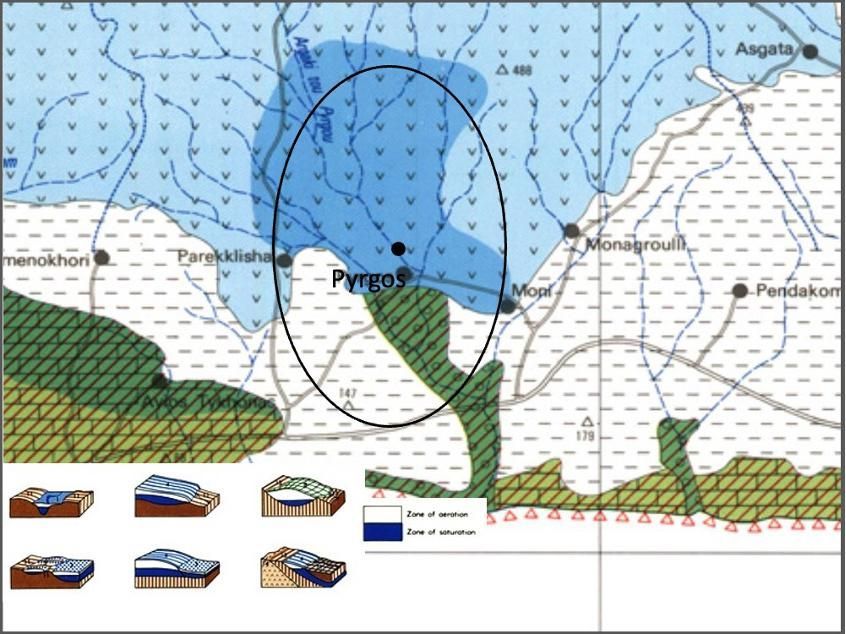
The site is located on a system of river terraces that descend from the Troodos Mountains to a low alluvial valley where a fan of streams converges four kilometres from the coast, once part of the sequence of wetlands that characterized the southern coast of Cyprus from the Akrotiri peninsula to the Gulf of Famagusta
Pyrgos/Mavroraki:
The Palaeolithic frequentation of the palimpsest site
There is an archaeological site in Cyprus that has shattered one of the most persistent prejudices of Levantine prehistory:
The belief that the island was never visited by humans before the very end of the Upper Palaeolithic.
It is called Pyrgos/Mavroraki, located in the Limassol district within the village of Pyrgos. It is not just one of the many archaeological sites from the Cypriot Bronze Age; it is much more. Since 1996, a team from the Italian National Research Council first discovered the Bronze Age settlement and then unearthed a site that had already been inhabited during the Neolithic and Pre-Neolithic periods, frequented in the Upper Palaeolithic, even earlier in the Middle Palaeolithic, and before that during the Acheulo-Yabrudian period between the end of the Lower Palaeolithic and the Middle Palaeolithic (www.pyrgos-mavroraki.eu). In other words, a palimpsest site where pre-Neanderthal human groups left traces of their passage with their tools, followed by Neanderthals and then Sapiens. These are the same groups that travelled along the opposite coasts of the Levant. From the tools, one can trace the creative evolution of human intelligence through millennia—objects made of quartz, quartzite, and flint, fragments of life that tell the story of a difficult struggle for survival and perhaps even the encounter between Neanderthals and Sapiens, already documented in Levantine sites like Misliya, Tabun and Qafzeh. The same place, the same river terrace, frequented generation after generation until the temporary abandonment of the site toward the end of the Middle Bronze Age, only to rise again nearby and become the current village of Pyrgos. Half a million years of history.
It is not just the layering that astonishes but the fact that the multi-millennial experience acquired in the same place gave rise to an industrial centre during the Bronze Age, where carbon-14 analyses testify to knowledge of copper metallurgy at the end of the fifth millennium BC. The same place where social, productive, and commercial life revolved around a large hall with an olive press at its centre, which also housed one of the oldest factories for perfumes and aromas, adjacent to a warehouse with enormous jars for oil and wine, perhaps both used in the parallel production of bronze objects, medicines, cosmetics, and textiles.
What is most surprising, however, is that the prosperity of the site was based not only on the perennial abundance of water but also on the availability of all the minerals and rocks used for both lithic industry and metallurgy. The ease of finding quartz, quartzite, and flint pebbles, along with basalt blocks and veins of malachite and chalcopyrite, made the site favourable for millennia and drove human creativity toward an increasingly precise technological path. From choppers to the Levallois core, to the creation of knives, blades, and agricultural sickles, and later toward the world of metals, accompanied by ceramics with coroplastic extensions that left rare images of rural life during the Bronze Age.
What Pyrgos/Mavroraki has given us and continues to give us is not the story of a small agricultural village where wandering human groups passed through tens of millennia ago, gathering what they could find. It is the story of a place where people knew how to arrive, what to bring, where to find the right materials, and what to hunt or gather.
A completely different image from the one told for decades about "wandering hominids" searching for prey. Pyrgos/Mavroraki is one of the rarest European and Levantine sites that demonstrate the exact opposite. It is highly likely that, within a narrow time frame and conditioned by being on an island, Neanderthals and Sapiens not only met but exchanged experiences, bridging the evolutionary gap that was believed to have existed until a few years ago.
C'è un sito archeologico a Cipro che ha distrutto uno dei pregiudizi più duri a morire della preistoria Levantina:
quello che l’isola non fosse mai stata visitata da esseri umani prima della fine ultima del paleolitico superiore.
Si chiama Pyrgos/Mavroraki nel distretto di Limassol all’interno del villaggio di Pyrgos. Non è uno dei tanti siti archeologici dell’età del bronzo cipriota, è molto di più. Dal 1996 in poi, un team del Consiglio Nazionale delle Ricerche Italiano ha prima scoperto l’insediamento dell’età del Bronzo e poi portato alla luce un luogo che era già stato abitato nel periodo Neolitico e Preneolitico, frequentato nel Paleolitico Superiore, ancor prima nel Paleolitico Medio e prima ancora nel periodo Acheulo-Yabrudian tra la fine del Paleolitico Inferiore e il Paleolitico Medio (www.pyrgos-mavroraki.eu). Vale a dire un sito palinsesto dove gruppi umani precedenti i Neanderthal hanno lasciato con i loro strumenti traccia del loro passaggio, seguiti dai Neanderthal e poi dai Sapiens. Gli stessi gruppi che transitavano lungo le opposte coste del Levante. Dagli strumenti si segue l’evoluzione creativa attraverso i millenni dell’intelligenza umana, oggetti di quarzo, quarzite e selce, schegge di vita che raccontano una difficile lotta per la sopravvivenza e forse anche l’incontro tra i Neanderthal e i Sapiens già testimoniato nei siti Levantini di Tabun, Misliya e Qafzeh. Lo stesso posto, la stessa terrazza fluviale frequentato da generazione in generazione fino al temporaneo abbandono del sito verso la fine del Bronzo Medio, per poi risorgere accanto e diventare l’attuale villaggio di Pyrgos. Mezzo milione di anni di storia.
Non è solo la sovrapposizione a destare stupore ma il fatto che l’esperienza plutimillenaria acquisita abbia fatto nascere nello stesso luogo un centro industriale nell’età del Bronzo dove le analisi al carbonio 14 testimoniano la conoscenza della metallurgia del rame alla fine del quinto millennio BC. Lo stesso luogo dove la vita sociale, produttiva e commerciale si svolgeva intorno ad una grande sala con al centro un frantoio per le olive che ospitava anche una tra le più antiche fabbriche di profumi ed aromi, adiacente un magazzino con enormi giare per l’olio e per il vino, forse entrambi impiegati nelle produzioni parallele di oggetti di bronzo, farmaci, cosmetici e tessili.
Ciò che però sorprende di più è che la prosperità del luogo fosse basata non solo sulla perenne ricchezza d’acqua, ma sulla disponibilità di tutti i minerali e le rocce impiegate sia per l’industria litica che per la metallurgia. La facilità nel reperire i ciottoli di quarzo quarzite e selce insieme ai blocchi di basalto ed alle vene di malachite e calcopirite ha fatto prediligere per millenni il luogo e spinto la creatività umana verso una strada tecnologica sempre più precisa. Dai choppers al nucleo Levallois, alla creazione dei coltelli, delle lame e delle falci agricole e poi più avanti verso il mondo dei metalli, accompagnato da una ceramica con estensioni coroplastiche che hanno lasciato rare immagini della vita rurale nell’età del Bronzo.
Quello che Pyrgos/Mavroraki ci ha regalato e ci sta regalando non è la storia di un piccolo villaggio agricolo dove decine di millenni prima erano passati gruppi umani vaganti che raccoglievano quello che trovavano. E’ la storia di un luogo dove le persone sapevano come arrivare, cosa portare, dove trovare i materiali giusti e cosa cacciare o raccogliere.
Un immagine del tutto diversa da quella raccontata per decenni di “ominidi” vaganti in cerca di prede. Pyrgos/Mavroraki è uno dei rarissimi siti europei e Levantini che dimostrano esattamente l’opposto. Dove, è molto probabile che in un intervallo temporale ristretto e condizionato dall’essere all’interno di un’isola ,i Neanderthal e i sapiens si siano non solo incontrati, ma abbiano scambiato esperienze, colmando quell’abisso evolutivo che si è creduto sia esistito fino a pochi anni fa.
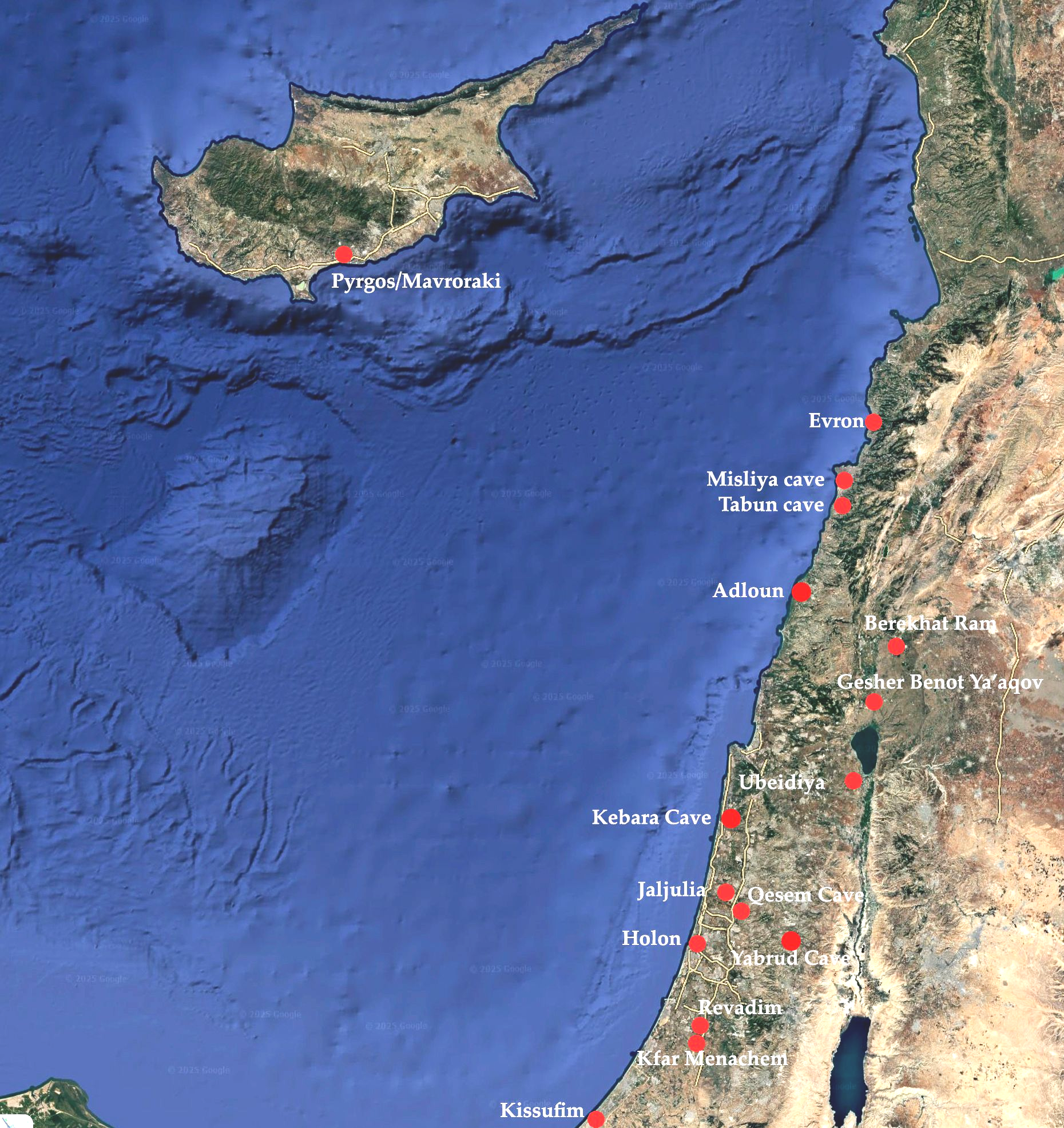
The lithic production displays a combination of technological systems strongly reminiscent of Levantine sites in the Syro-Palestinian corridor such as Qesem cave, Tabun cave, Kebara cave, Yabrud cave, Adloun, from which Pyrgos/Mavroraki differs significantly, as the insularity and a diverse raw material landscape created the conditions in which Levantine technological repertoires were transformed and recombined in a local technological hybridization.
The presence of such an ancient assemblage of stone tools, far from being a coincidence with the later Neolithic occupation of Pyrgos/Mavroraki, provides unsurprising evidence of human presence in Cyprus at the beginning of the Middle Palaeolithic, placing the island among the best-known Mousterian sites in the Levant.
The coexistence of technological traditions associated with the late Lower Palaeolithic – early Middle Palaeolithic (e.g., Tayac tools) with unambiguously late Acheulean, Tayac, Quinson, Quina and Levallois artefacts strongly suggests that human groups visited Cyprus repeatedly from the Levantine coast, probably starting from the Lower Palaeolithic.
The first Techno-Cultural Phases regard the end of the Acheulean period.
a.The Late Acheulean (LA, 780–400 ka)
The Late Acheulean of the Levant is characterised by well-shaped bifaces, refined flint workmanship, and hierarchical flaking strategies. Detailed analyses of key open-air sites such as Kefar Menahem West, Revadim, and Holon demonstrate substantial intra-assemblage variability in raw material procurement, reduction sequences, and tool types. Contrary to the traditional view of the Acheulean as a phase of cultural stasis, the Levantine evidence reveals significant local experimentation and technological flexibility, suggesting small, low-density populations capable of innovation, albeit with limited intergroup transmission.
b.The Acheulo-Yabrudian (A-Y, 400–250 ka)
The Acheulo-Yabrudian (A-Y) complex represents a genuine transitional phase between the Acheulean and the Middle Palaeolithic. Documented at sites such as Zuttiyeh Cave, Tabun (Layers E–F), and Qesem, the A-Y assemblages display a mixed technological repertoire:
● Persistence of bifaces, though in reduced frequency.
● Emergence of intentional thick-flake production and use of Quina retouch for robust scrapers.
● Introduction of laminar and blade reduction sequences .
● Presence of obsidian artefacts
This combination of archaic and innovative elements reflects an evolutionary process of “descent with modification”, rather than abrupt cultural replacement.
From a behavioural perspective, A-Y groups appear highly mobile, exploiting small territories repeatedly. The technological diversity and site variability suggest flexible, adaptive strategies and a fragmented but dynamic cultural landscape.
c. The Early Middle Palaeolithic (EMP, 250–160 ka)
The Early Middle Palaeolithic in the Levant marks the full emergence of the Levallois and laminar technological systems, representing one of the earliest and most coherent regional expressions of the Middle Palaeolithic worldwide. Documented at the Misliya, Tabun and Cafzeh caves (Zaidner, Weistein-Evron 2020).
Key features include:
● The coexistence of three main reduction strategies—Levallois, Laminar, and core-on-flake.
● Predominance of elongated blades and points (e.g., Abou-Sif and Hummal types).
● Systematic preparation of faceted striking platforms and hierarchical volumetric control.
● Standardized production of blanks for retouched tools indicating advanced planning and conceptualization.